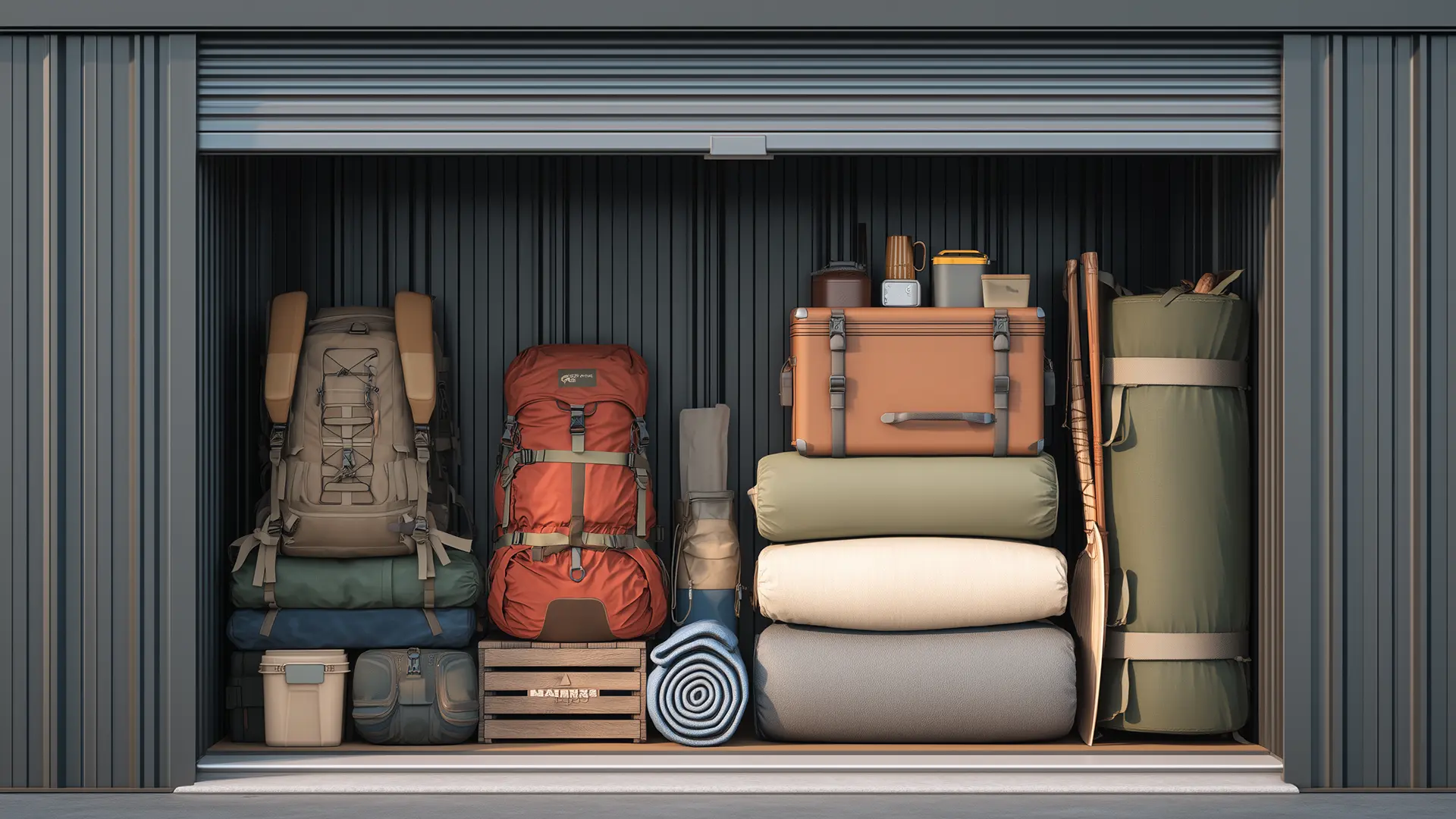
Where to store your camping gear between summer adventures?
Tent, sleeping bags, air mattresses, stove, coolers, folding chairs… Where and how to store camping gear between summer trips, at home or in a self-storage unit in the Basque Country.
Weekend under the stars, road trip in a van, family campsite… Summer is often dotted with several getaways. Your camping gear goes in and out constantly: tent, sleeping bags, air mattresses, stove, coolers, folding chairs, tarp, lanterns… Between trips, all this equipment usually ends up piled up in the hallway, living-room or garage. Storing it properly between summer escapes will both save space at home and keep your gear in good condition for longer.
Why store camping gear properly between trips?
Leaving everything in the car boot or in a heap in the corner might be tempting – but it comes with a cost.
- Damp and mould in tents, sleeping bags and mattresses that are packed away while still wet.
- Persistent smells in fabrics and coolers that have not been fully dried.
- Premature wear and tear on poles, pegs, zips and fabrics stored badly.
- Damage to folding chairs, stoves and lanterns when they are thrown into a pile.
- Permanent clutter in already compact flats, especially in cities or on the Basque coast.
A few simple return-from-camping habits and a suitable storage space (cupboard, cellar, self-storage unit) are enough to make your next departures much easier.
Step 1: clean, dry and sort after each trip
Between summer getaways, the first step starts as soon as you get back home.
- Air out the tent (at least out of its bag) and let it dry completely, especially after dew or rain.
- Shake out groundsheet, sleeping bags and liners to remove sand, grass and pine needles.
- Wipe and air coolers, open compartments and let them dry fully.
- Check and group pegs and poles together in a dedicated bag or box.
- Inspect your gear (punctured mattress, broken zip, torn fabric) and set aside what needs repairing.
Tip: create a dedicated “back from camping” area (balcony, yard, ventilated room) so you can dry and check all your gear before putting it away or taking it to a unit.
Step 2: storing between two close-together weekends
If you are heading back to the campsite the following weekend, there is no need to bury everything in the back of a cupboard.
- Prepare a “ready-to-go camping” box or bag with the essentials (tent, pegs, sleeping bags, mattresses, stove, camping cookware).
- Keep this box in an accessible spot: hallway, bottom of a cupboard, or in the car boot if you have secure parking.
- Leave some items pre-packed (toiletry kit, basic kitchen gear, headtorch) to save time for each departure.
- Create a simple checklist (on paper or on your phone) attached to your camping box.
- Store more specialised items separately so you don’t have to unpack everything for a simple weekend.
Between close-together trips, the goal is to reduce handling while still avoiding damp and chaos in your living-room.
Step 3: storing camping gear for several weeks
If the next trip is not planned for several weeks, it is worth choosing a more long-term storage solution.
- Avoid very damp cellars for tents, sleeping bags and textiles.
- Protect stoves, cookware and accessories from dust using boxes, covers or fabric bags.
- Keep tents and plastics away from direct sun to prevent fading and weakening.
- Raise boxes and tubs off the floor if you store them in a garage or uninsulated outbuilding.
- Group all your camping gear in one place so you can find it quickly.
If you lack storage space at home or your cellar is not suitable, a self-storage unit is an ideal base for all your camping activities.
Storing camping gear at home: a few ideas
If you live in a flat in Bayonne, Anglet or Biarritz, every square metre matters. A few tricks can help you keep some gear at home without feeling overwhelmed.
- Top shelves of cupboards for sleeping bags and tents in breathable bags.
- Under-bed storage tubs for smaller items such as lighting, cookware and dry bags.
- Storage benches in the living-room or hallway for folding chairs and blankets.
- Garage or utility room shelves for coolers, camping chests and stoves.
- A dedicated “outdoor” cupboard that also holds hiking and beach gear.
But if your home is already full, it can be more comfortable (and cost-effective) to move part of your camping kit into a storage unit.
When self-storage becomes your “camping locker”
For families, vanlifers or enthusiastic campers, gear quickly takes over. A self-storage unit can become a dedicated camping and outdoor hub.
- Free your living-room, cellar and balcony from tents, coolers, chairs and trunks.
- Store everything in a clean, dry space, safe from rodents, damp and extreme temperatures.
- Group camping, hiking and beach gear together in one place.
- Prepare big trips in advance (summer holiday, road trip) directly in the unit.
- Enjoy flexible access to grab only what you need for a short weekend away.
On the BAB, where many homes are compact, a few square metres of storage can act as a dedicated “camping garage” outside your flat.
What size unit for camping gear?
The good news: even regular campers do not usually need a large unit.
- 1 m² for a light camping kit (2–3 person tent, sleeping bags, compact mats, small stove, soft coolers, a few boxes).
- 1.5–2 m² for a family (family tent, several mattresses, big sleeping bags, hard coolers, folding chairs, chests).
- 2–3 m² if you also store hiking gear, beach equipment and maybe bikes or a roof box.
You can fine-tune this using our online size calculator and by asking our teams in Bayonne, Anglet or Biarritz.
Organising a “camping & outdoor” unit
With a bit of planning, your unit becomes your launchpad for every trip.
- Add a shelving unit for boxes and crates (sleep, kitchen, lighting, care).
- Use transparent or clearly labelled boxes so you can see the contents at a glance.
- Create zones such as “night” (tent, sleeping bags, mats), “kitchen”, “kids”, “safety & first aid”.
- Keep a “ready-for-the-weekend” box at the front with only the essentials.
- Hang a checklist on the inside of the door so you never forget key items before leaving.
Case study: a camping family that finally regains space at home
In Bayonne, Sophie and Karim go camping several times each summer with their two children. Their 3-room flat is crammed with family tents, mattresses, sleeping bags, coolers and folding chairs, plus hiking and beach gear. They decide to rent a 2 m² unit in a self-storage centre on the BAB. They install shelving, store all their camping gear by category and keep only a few items at home for last-minute trips. The result: a home that finally breathes again and camping weekends that are much easier to prepare.
More ideas for outdoor gear storage
- Dry and check your camping gear as soon as you get home to avoid mould and surprises.
- Between close-together trips, keep a “ready-to-go” camping box to simplify packing.
- If space is tight, move part of your camping kit to a self-storage unit.
- Organise your unit into clear zones (sleep, kitchen, kids, safety) so you can pack in minutes.
- Use self-storage as your “camping locker” so you can enjoy summer adventures without cluttering your home.
Is your camping gear taking over your living-room between weekends in the great outdoors? By cleaning, organising and storing it in a self-storage unit in Bayonne, Anglet or Biarritz, you can free your home and prepare your trips more calmly. Estimate your needs, explore our centres on the BAB and book your unit online in just a few clicks.